




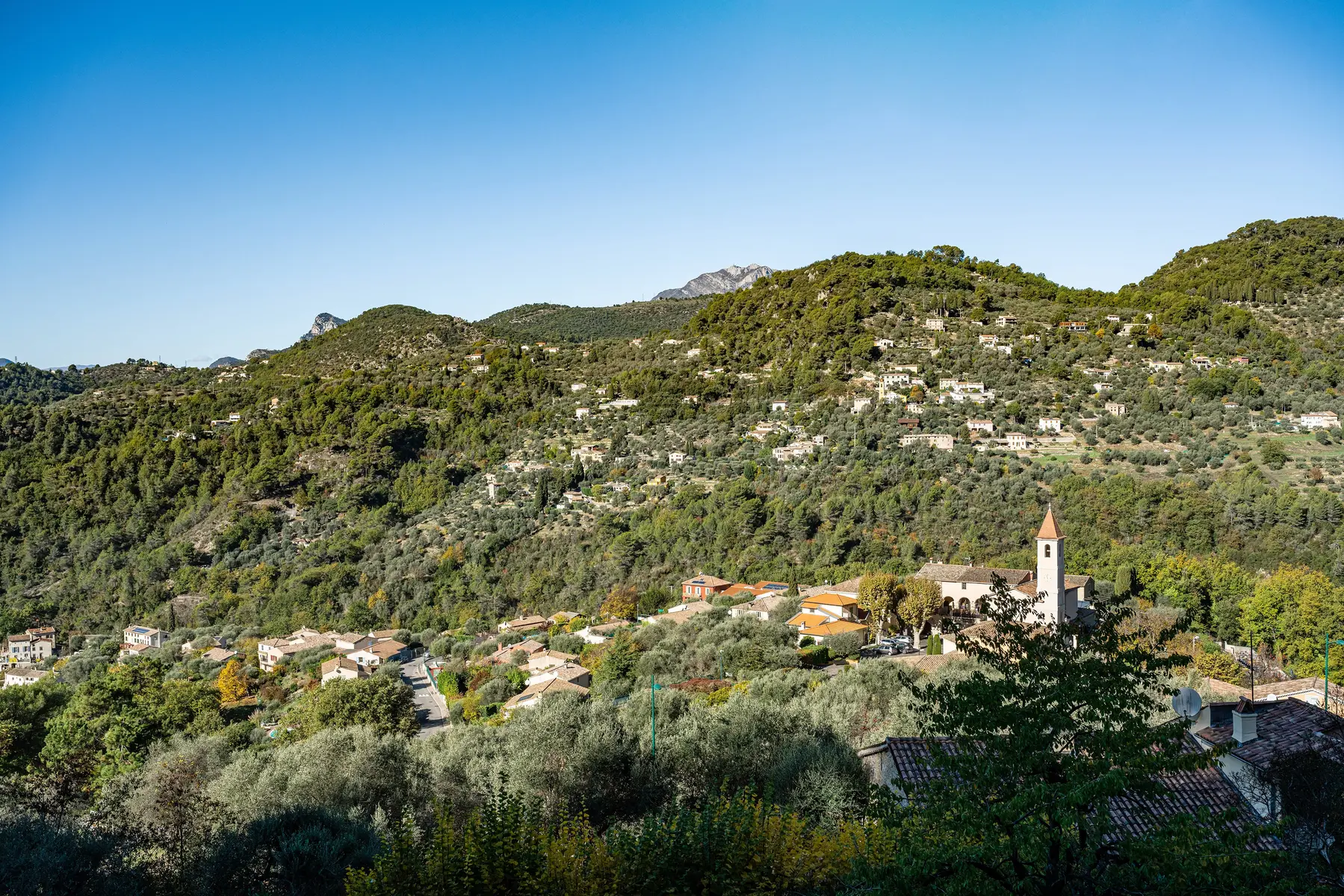

Arriving from Levens, you'll have crossed the Masséna bridge, suspended over the Amandier valley, but it's in olive-growing country that the journey continues.
Landscape interpretation :
The origins of the commune of Saint-Blaise have had a major impact on the landscape. Villa Sancti Blasii is mentioned as early as 1075. Declared uninhabited at the end of the 14th century, Louis Grimaldi de Beuil, former bishop of Vence, succeeded in establishing a new population in 1607 by means of a deed of habitation, using the emphyteutic lease system. The land was divided into quartons and granted to families who cleared the land, built restanques and planted vines and olive trees.
In the center of this view, the yellow bell tower of Saint Antoine de Siga, which you passed coming from Levens, stands out from the landscape, a real immersion in olive-growing land.
The restanque remains a strong marker of the Saint-Blaise landscape, as does the olive tree that stands on these terraces, which enjoys a sunny exposure and whose silhouette, sometimes 8 to 10 meters high, is an essential element. Its grey-green foliage and weeping willow-like appearance, with its long, drooping branches, reveal a serene, unchanging landscape. The colors and texture of the olive groves contrast with the soft green of the pines, which grow on limestone areas where soil is scarcer, and with the dark green of the cypresses and their slender, vertical form. Often planted close to homes, cypresses are a welcome sight.
