



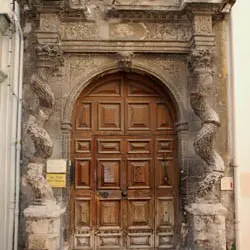
Date: 17th century
Period: Classical
Type : Domestic architecture
Status : Private property Listed as a Historical Monument (1925)
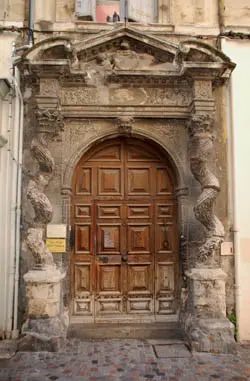
The Hôtel de la Lauzière bears witness to the upward social mobility of Arles' wealthy families during the Classical period, and to their architectural influence on the town's urban planning. Originally built in the early 17th century in the central district of the Cité, the building's facade, rebuilt in the 18th century, has fortunately preserved one of Arles' most beautiful portals. Indeed, its astonishing torso columns are a unique example, visible outdoors throughout the city (several church altarpieces, including that of La Major, are in the same style). This is a Mannerist style. Between the Renaissance and the Baroque, this architectural style asserts the primacy of artistic processes over the simple representation of forms inspired by Antiquity.
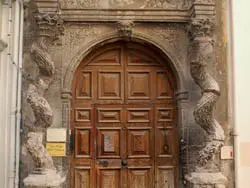
The soberly decorated 18th-century façade contrasts with the Mannerist style of the portal, which has fortunately been preserved from the earlier building. These support an entablature with a frieze decorated with foliage and a triangular pediment with modillions, with scrollwork on the right and left. The door's semicircular arch is adorned with a mascaron (fantasy figure). It is framed by two sculpted spandrels (triangular surfaces, pointing downwards, between two arches).
Location
- www.patrimoine.ville-arles.fr
Environment
Environment
- Town location