



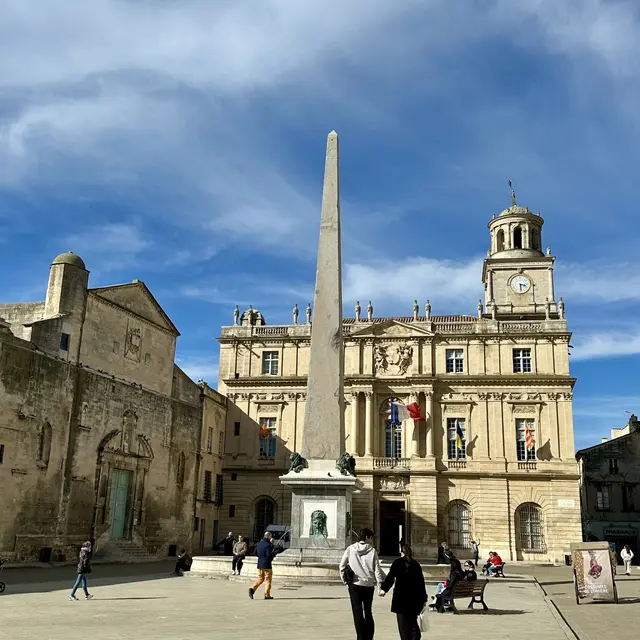
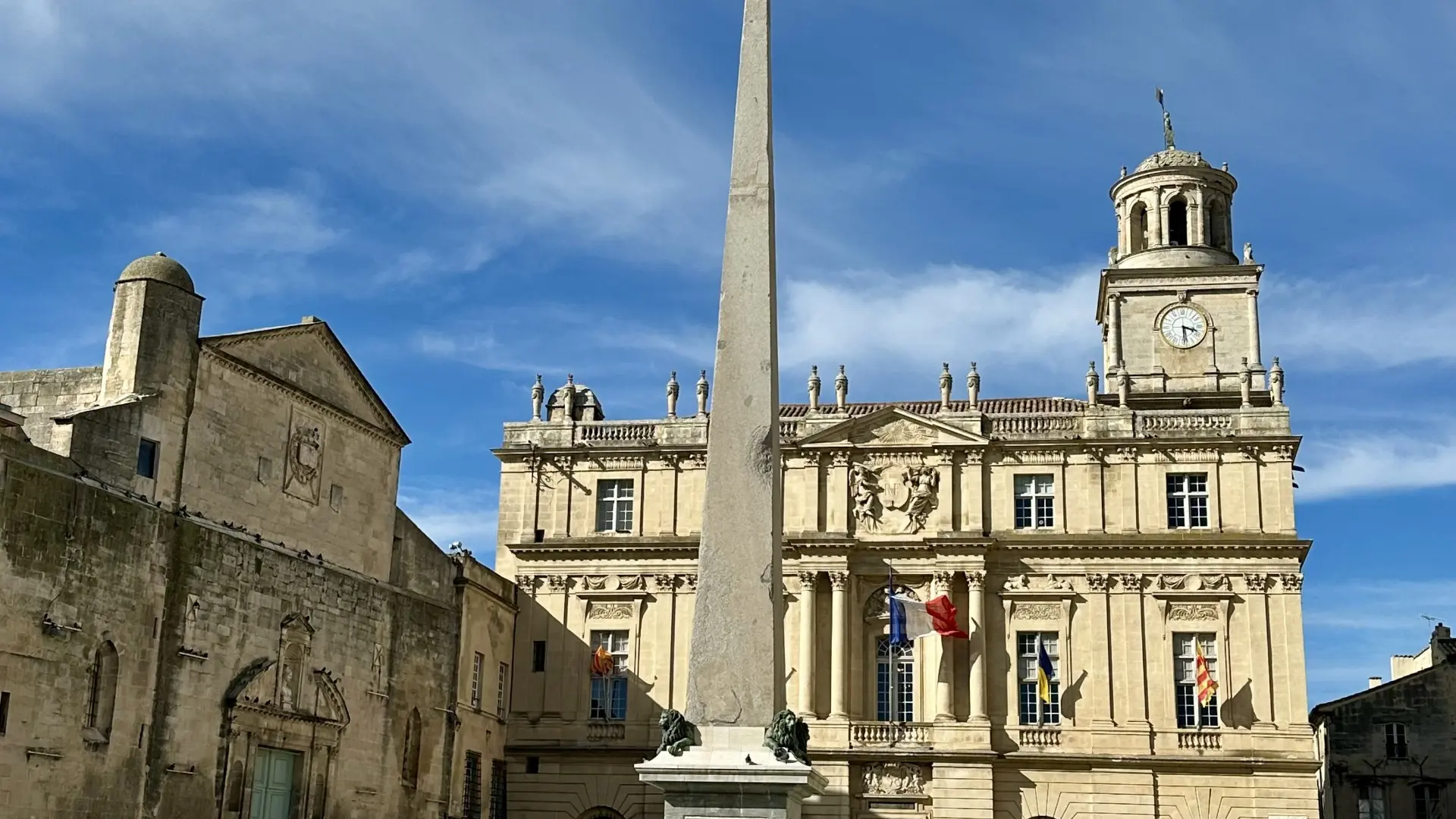
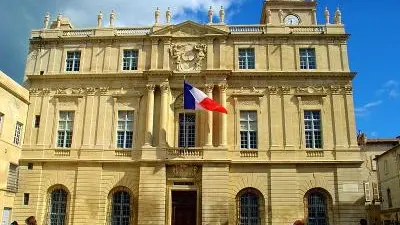
The Arles Town Hall, located on the Place de la République, was completed in 1676, and most of it is now a listed building. It is still the headquarters of the Arles Town Hall.
Date: 1676
Period: Classical
Type : Public community architecture
Status : Property of the City of Arles, classified as a historic monument (1920)
Master builder : Jacques Peytret and Jules Hardouin-Mansart
In the heart of the city, a symbol of power and witness to a century of magnificence, the town hall masterfully closes the perspective of the Place de la République. Completed in 1676, after much study and laborious construction, it marks the triumph of classical architecture, inspired in particular by Jules Hardouin-Mansart, appointed architect to Louis XIV that same year. It replaces a former community house that stood between the king's house (formerly the Podestats' palace) and the clock tower, which the town's councillors wished to preserve. The building is particularly admirable for the richness of its decoration, sculpted in large part by the Arles-born Jean Dedieu, and for the barrel vaulting of its vestibule, a daring technical feat for its time.
Most of the building has been classified as a historic monument, but it remains the seat of elected representatives and part of the municipal administration.
Elevation of the south facade of the Town Hall
The Hôtel de Ville marks the triumph of the classical style. Built on three levels, the first floor is treated as a pedestal, with an embossed decoration. The second floor, known as the "noble" floor, features an imposing central decor with double columns framing a French window opening onto a balcony with a stone balustrade. The second floor is dominated by a central pediment featuring a sun, the symbol of Louis XIV, and a décor of balusters and fire pots. The flat vaulting of the vestibule is formed by two perpendicular cradles of unequal widths and basket-handle lunettes. Double columns support the vault on either side of the vestibule. The entrance to the main staircase, which leads to the council chamber, is framed by two stone lions sculpted by Jean Dedieu, a sculptor from Arles, who did most of the interior and exterior decoration. Part of this decoration was lost during the French Revolution. The council chamber has preserved its fine 18th-century woodwork by Laurent Bondon, who also created the ceiling. The medallions, painted by Mandon de Cazan, depict the ancient monuments of Arles. The relief ornaments were executed by Antoine Reynaud. Above the panelling, fluted pilasters frame the trophies. The frames decorating the room are integrated into the woodwork and feature paintings by Jean Roche (circa 1920).
Location
- www.patrimoine.ville-arles.fr