



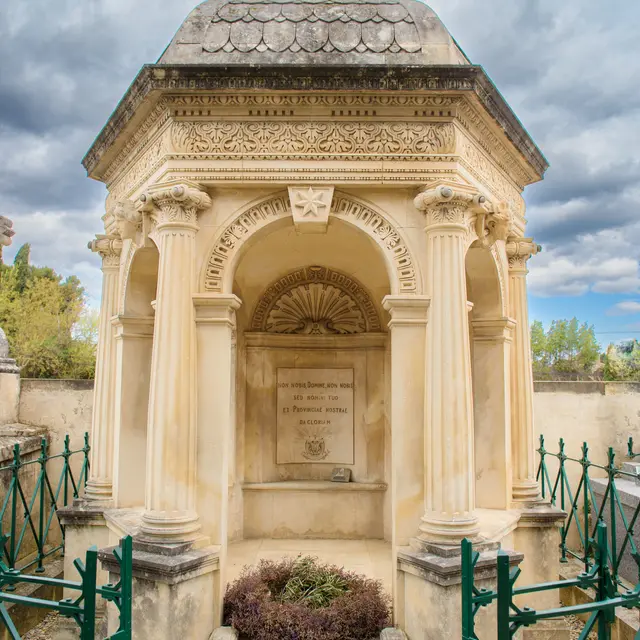
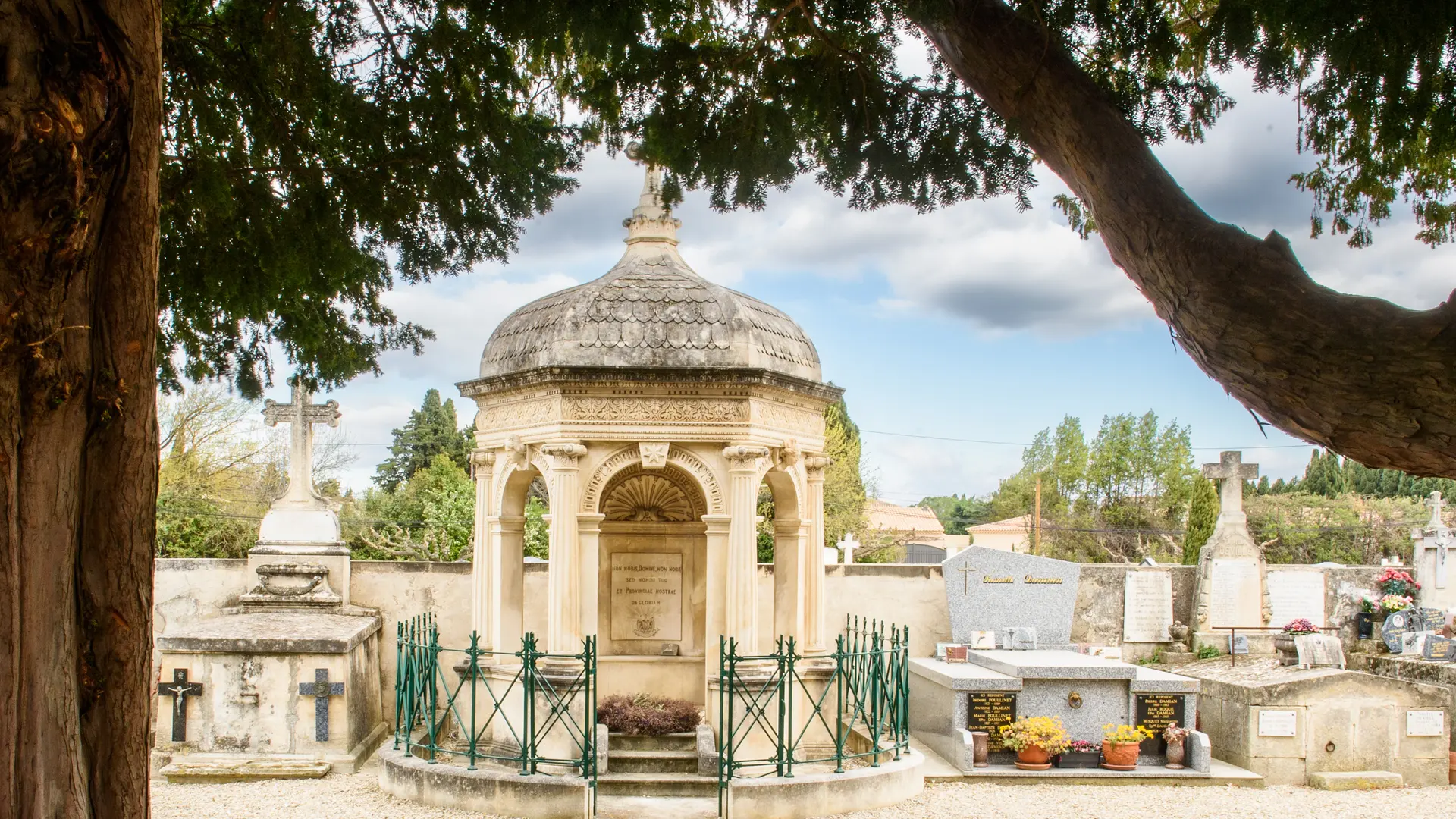
Frédéric Mistral had his tomb built in 1907, before his death in 1914; it is a very faithful replica of the Pavillon de la Reine Jeanne in Les Baux-de-Provence. On the bell which sounded his death-knell and announced his loss, there is an engraving of a 1907 poem called 'Moun toumbéu' (My tomb'). It was engraved several days before his death and it was when Mistral went to admire the sculptor's work in the church that he caught a chill and died.
Architectural description
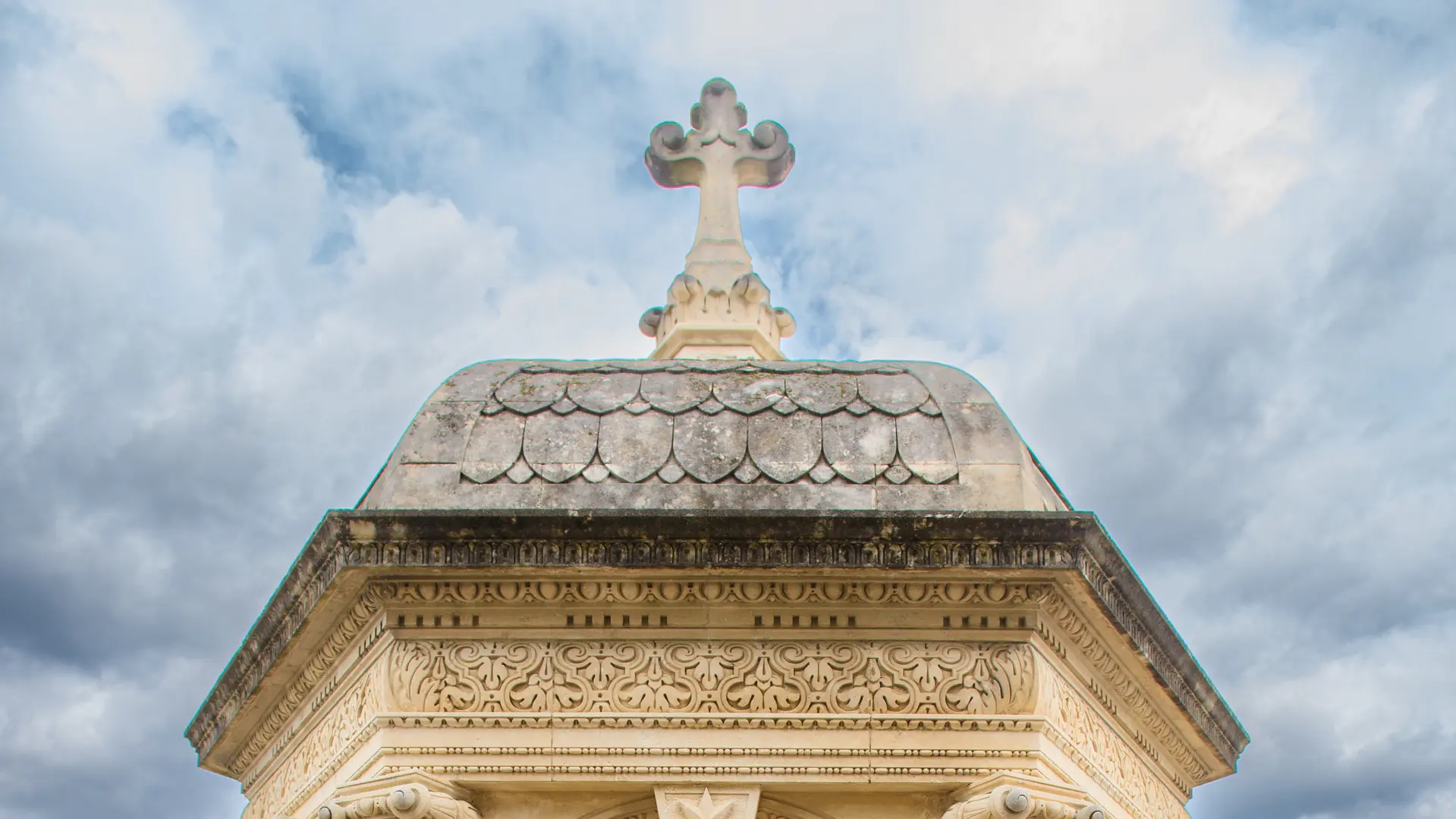
Small Renaissance-style hexagonal building, with semi-circular openings on five of its sides and a domed roof surmounted by a stone cross. Six fluted columns topped with composite order capitals - i.e. they have both the characteristic scrolls of the Ionic order and the acanthus leaves of the Corinthian order - support an entablature composed of an architrave with three fasciae adorned with beads and swirls and a wide, intricate frieze. On top of this is an impressive, extensively decorated cornice. The keystone of the main opening features a bas-relief of the seven-point star of the Félibrige Association. The openings of the other bays represent the faces of young girls - a Mireille and an Arlésienne. Two others are sculpted in the image of the poet's two dogs (Pan Panet & Pan Perdu). The base of the edicule has been designed like a small altar, above which is the following inscription: 'non nobis domine, non nobis, sed nomini tuo, et Provinciae nostrae da gloriam' (which translates as 'No, not to us, Lord, but to Your name and to our Provence, give glory'). Under the inscription are Mistral's coat of arms and motto, 'Lou souleu me fai canta' ('The sun makes me sing'). The building is a reinterpretation of a Greek tholos, or small circular temple.
Location
Contact Tmbeau de Frédéric Mistral
- maillane.fr
- www.instagram.com