



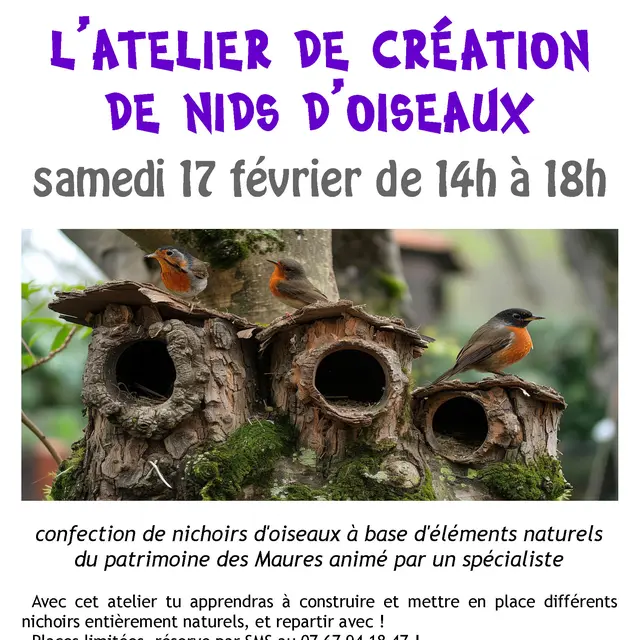
Making bird nesting boxes using natural elements from the Maures heritage. Activity led by a specialist.
An opportunity to discover the specific features, construction, installation and accessories of nesting boxes.
An opportunity to discover the specific features, construction, installation and accessories of nesting boxes.
The bird nesting box workshop is open to all, especially children, who can learn about the links that maintain biodiversity and contribute to the balance of our local ecosystem.
The nesting boxes made can be collected by the participants and installed in the place of their choice
Participation in this workshop is free of charge, and the funds raised will be entirely donated to the association in order to perpetuate its activities.
As part of its efforts to promote knowledge of the ecosystem of the Maures massif, the ECOLLO association is offering a workshop to make bird nesting boxes using natural elements from the Maures heritage.
On the afternoon of 17 February, in the outdoor area of the Écollocal, we will be offering a workshop using all the materials needed, sourced exclusively from the local area, to make nesting boxes for the small birds that are looking for them, and also for small owls.
The afternoon of Wednesday 7 February will be set aside for preparing the nesting boxes, i.e. collecting the trunks and peg rods, cutting them into sections and pre-assembling them. Everyone is welcome to get involved and come up with ideas!
It's before spring that certain cavity-nesting birds - species that build their nests in natural cavities, such as tits, wagtails, sparrows and rigaous - locate a potential nesting place for their reproduction and the summer months. With the destruction of habitats and natural cavities becoming rare, this is a beneficial action that can help preserve these protected species, some of which are on the verge of extinction.
The materials used in the construction are mainly made from cork oak bark recovered from dead trees in the forest whose trunk wood has been completely devoured by worms and larvae over time. The roof and base are pegged together using wooden rods or small bamboo. The interior can be lined with raw sheep's wool or moss. Depending on the species of bird envisaged, the volume and orientation will differ. The trunk is used horizontally, for example, for the little owl, which is familiar in our regions.
The nesting boxes made can be collected by the participants and installed in the place of their choice
Participation in this workshop is free of charge, and the funds raised will be entirely donated to the association in order to perpetuate its activities.
As part of its efforts to promote knowledge of the ecosystem of the Maures massif, the ECOLLO association is offering a workshop to make bird nesting boxes using natural elements from the Maures heritage.
On the afternoon of 17 February, in the outdoor area of the Écollocal, we will be offering a workshop using all the materials needed, sourced exclusively from the local area, to make nesting boxes for the small birds that are looking for them, and also for small owls.
The afternoon of Wednesday 7 February will be set aside for preparing the nesting boxes, i.e. collecting the trunks and peg rods, cutting them into sections and pre-assembling them. Everyone is welcome to get involved and come up with ideas!
It's before spring that certain cavity-nesting birds - species that build their nests in natural cavities, such as tits, wagtails, sparrows and rigaous - locate a potential nesting place for their reproduction and the summer months. With the destruction of habitats and natural cavities becoming rare, this is a beneficial action that can help preserve these protected species, some of which are on the verge of extinction.
The materials used in the construction are mainly made from cork oak bark recovered from dead trees in the forest whose trunk wood has been completely devoured by worms and larvae over time. The roof and base are pegged together using wooden rods or small bamboo. The interior can be lined with raw sheep's wool or moss. Depending on the species of bird envisaged, the volume and orientation will differ. The trunk is used horizontally, for example, for the little owl, which is familiar in our regions.