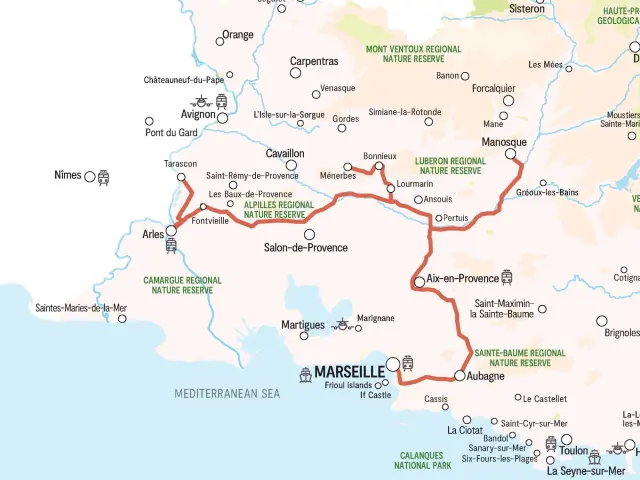
 Carte Tour 39
Length: 7 days, 6 nights
Total distance covered: 406 km
Main access points:
- Marseille airport
- Aix-en-Provence TGV train station
Departing from:
- Avignon TGV train station
 Jean Giono writing at his deskCarte Tour 39
Length: 7 days, 6 nights
Total distance covered: 406 km
Main access points:
Departing from:
You will love
It was here at 14, Rue Montaux – renamed Rue Edmond Rostand 50 years later – in the Préfecture quarter of Marseille, that the poet and playwright Edmond Rostand was born on April 1st, 1868. He studied literature at the Lycée Thiers, then went on to write Cyrano de Bergerac in 1897 – one of the most popular verse plays in the history of French theatre and an absolute triumph at the time. The play tells the story of a brilliant poet who is insecure about his large nose. Although secretly in love with his cousin Roxane, he agrees to write letters on behalf of the inarticulate Christian to help him seduce her. Following Edmond Rostand’s death on February 20th, 1919, his body was brought back to Marseille and displayed at the Palais Carli, now home to the School of Fine Arts. He was later buried at the Saint-Pierre cemetery, and his tombstone was restored in 2017.
Night in Marseille
Distance covered on Day 1: 0 km
Must-sees:
Provence’s most famous author, Marcel Pagnol was born on February 28th, 1895 in Aubagne – a village renowned for its traditional Santon figurines. His birthplace, now a museum dedicated to Pagnol’s life, highlights his immeasurable literary legacy. The four volumes of his childhood memories – My Father’s Glory, My Mother’s Castle, The Time of Secrets and The Time of Love -, relating his summer holiday adventures in the wild hills surrounding the village of La Treille, captured the timeless essence of Provence forever more. In parallel, the Marseille Trilogy – Marius, Fanny and César -, which he later adapted to the big screen, paints a delightfully colourful and witty portrait of the people of Provence.
Night in Forcalquier
Distance covered on Day 2: 138 km
From the heights of its rocky spur, Gordes, one of “France’s Most Beautiful Villages”, is a genuine jewel of the Luberon. Its cobbled streets, dry stone houses and spectacular views over the valley offer the perfect Provençal decor. A few kilometres away, the Provençal Colorado in Rustrel unveils an astonishing landscape of flamboyant orange hues, forged by the old ochre quarries. The spectacle continues in Roussillon, another iconic Luberon village, where the ochre trail and Okhra ecomuseum tell the fascinating tale of this natural pigment. The voyage heads skywards at the Astronomy Centre in Saint-Michel-l’Observatoire, inviting you to marvel at the cosmos to your heart’s content. Last but not least, Salagon Priory and its specialist gardens in Mane are the perfect place for a cultural and botanical break, while La Caramelerie promises a delicious taste of childhood…
Night in Aix-en-Provence
Distance covered on Day 3: 94 km
Must-sees:
Nestled between vineyards and olive groves, the charming hilltop villages of Bonnieux and Ménerbes, in the Luberon Regional Nature Reserve, promise love at first sight. So much so that some people leave everything behind to set up home there… English author Peter Mayle (1939-2018) is, of course, world-famed for his novel A Year in Provence – a deliciously witty autobiographical work published in 1989, in which he recounts the eventful arrival of a London couple at a Provençal farmhouse. Filled with hilarious clichés and culture clashes, the book sold millions of copies and was translated into dozens of languages. Mayle went on to publish around a dozen works all set in Provence, making him the Provence-Alpes-Côte d’Azur region’s most fervent English-speaking ambassador.
Night in Lourmarin
Distance covered on Day 4: 80 km
Must-sees:
Alphonse Daudet was born in Nîmes on May 13th, 1840 and grew up in Provence, a place that provided endless inspiration for his oeuvre. He returned to his childhood home after several years spent in Paris, and published Letters from My Windmill shortly afterwards: a collection of short stories including the particularly famous The Brave Little Goat of Monsieur Seguin. The windmill in question is the Moulin Saint-Pierre, perched on a plateau overlooking the village of Fontvieille, amid the limestone cliffs of the Alpilles Regional Nature Reserve. Daudet described it as, “A ruin; a crumbling debris of stones and old planks, which hadn’t been windblown for years and which was lying, useless as a poet, while all around on the coast the milling industry flourished and spread its wings.” Thanks to his illustrious prose, the “ruin” is now a listed monument!
Night in Fontvieille
Distance covered on Day 5: 67 km
The Museon Arlaten in the historic quarter of Arles, a stone’s throw from the Cryptoporticus, is a must-do tour venue, dedicated to upholding Provençal traditions since 1909. Its inauguration date was no accident: author and poet Frédéric Mistral brought the museum to life with the money he received after winning the Nobel Prize in Literature in 1904 for his poem “Mirèio”, written in Provençal, relating Mireille and Vincent’s thwarted love story. Born in 1830 in Maillane, near Saint-Rémy-de-Provence, Mistral never ceased to fly the flag of Provence and its traditional language. In 1854, he founded the Félibrige alongside six other passionate poets: an association-come-literary movement dedicated to keeping the Provençal language alive.
Night in Arles
Distance covered on Day 6: 10 km
The legacy of Alphonse Daudet lives on in the town of Tarascon, panning out under an impressive medieval castle on the banks of the Rhône. In The Prodigious Adventures of Tartarin of Tarascon, the first in a series of three novels published in 1872, the anti-hero Tartarin, known for his tall tales and exaggerated stories about his travels and adventures, decides to embark on a real-life adventure and sets out for Algeria to hunt lions… A cornerstone of Provençal folklore, Tartarin now has his very own statue on Place Bâtonnier Louis Gontier. The town’s Museum of Art and History, set inside the former Couvent des Cordeliers, also tells his epic tale. And every year in early summer, during the must-see Fêtes de la Tarasque, parades, folk groups and shows pay Tartarin a well-deserved tribute.
Depending on the demands of your custurmers, please contact from the list below the professional best suited to respond.
Mondoramas Voyages (Groups)
[email protected]
+33 (0)442 360 374
mondorama.com