



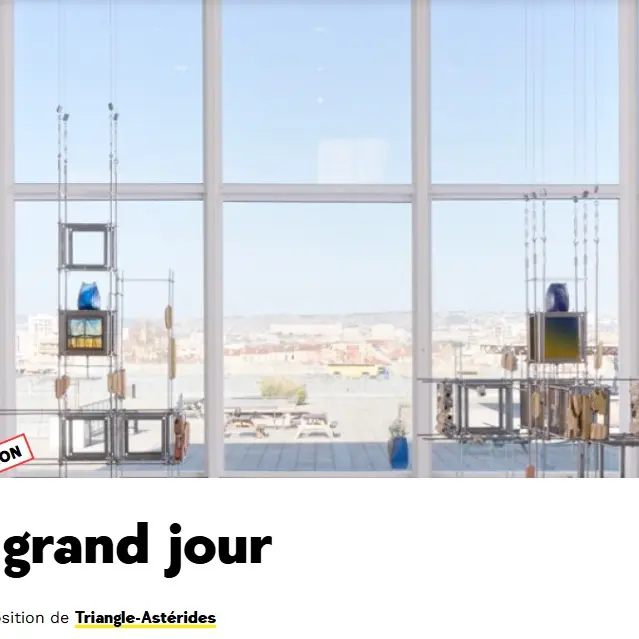
Invited to design a double solo show between Marseille and Avignon, her first institutional presentation in France, artist Agata Ingarden has imagined the two exhibitions as "two distinct atmospheric states...
Invited to conceive a double solo exhibition between Marseille and Avignon, her first institutional presentation in France, artist Agata Ingarden imagined the two hangings as "two distinct atmospheric states, through which we perceive the same reality".
Responding to the works presented at Friche la Belle de Mai, all made of glass and playing with the illusion of transparency, of a gaze through which nothing would resist, the whole of the Collection Lambert is discovered under the sign of moonlight and darkness.
In each location, the artist sees the lift-sculptures as "portals", giving access to the enigmatic "Dream House World". "Dream House is not a narrative with a beginning or an end," Agata Ingarden tells us, "but a fictional infrastructure. It's only important to understand that there is an underlying system [to our reality]. We don't know exactly what's going on there, but we can [imagine it."
This fictional universe, the organizing principle of Agata Ingarden's productions, is structured around four distinct rooms whose names evoke music and dance, trance perhaps, or at any rate a form of isolation within the collective: the 'rave', 'metal', 'base' and 'rhythm rooms'.
These are the very different architectures sketched out by the eight "Hermits", original sculptures connecting the two exhibitions, like a mysterious passage. Made from the debris of building materials from Agata Ingarden's current Pharaonic construction site in Ellinikon, near Athens, these sculptures evoke the hermit crabs that lodge in the empty shells of extinct molluscs, as well as the solitude of hermit lives.
In both cases, it's a retreat into interiority. Yet Agata Ingarden's "Hermits" seem empty, and their glass windows, whose iridescence evokes perpetual sunsets, expand dangerously outwards, as if threatening to explode.
