


In 2022-2023, Bella and Meret Meyer, granddaughters of Marc Chagall, enabled 141 works by their grandfather to enter the national collections by making several donations to the National Museum of Modern Art, Centre Georges Pompidou.
First exhibited in Paris in 2023-2024, the collection of works has now arrived at the Musée National Marc Chagall, where it is presented in two parts. It showcases the richness and diversity of Chagall's creative output and offers a journey through four sections.
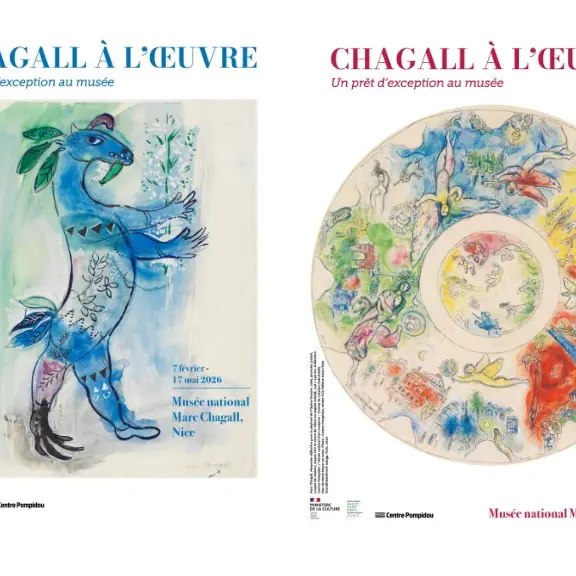
The forty-one sketches and models for the ceiling of the Opéra Garnier, inaugurated in 1964, illustrate the creative process behind one of Chagall's most ambitious public commissions. He first conceived his composition in terms of colorful rhythms, then incorporated iconography that paid homage to the great composers he admired and to the city of Paris, where he settled in 1923.
A second group of works comprises the sixty-four sketches for the stage curtains and costumes of the ballet The Firebird, set to the score by Igor Stravinsky, revived by the New York City Ballet in 1945, choreographed by Adolph Bolm, and then in 1949 by George Balanchine. Here, Chagall explored monumentality in his painting and the movement of bodies on stage.
Finally, the twelve ceramics and sculptures, followed by the twenty-four collages, reveal the artist's constant curiosity for new artistic practices in the 1950s to 1970s. His work with clay and stone began in 1949 when he settled in Vence and met Serge Ramel, Suzanne and Georges Ramié, and Lanfranco Lisarelli. Later, between 1960 and 1970, he developed the practice of collage using cut paper and fabric. The artist considered these works both as studies for monumental projects and as purely formal explorations.
Exhibition organized in two parts, with a rotation of works, from February 7 to May 17, 2026, and then from May 23 to September 21, 2026.
The forty-one sketches and models for the ceiling of the Opéra Garnier, inaugurated in 1964, illustrate the creative process behind one of Chagall's most ambitious public commissions. He first conceived his composition in terms of colorful rhythms, then incorporated iconography that paid homage to the great composers he admired and to the city of Paris, where he settled in 1923.
A second group of works comprises the sixty-four sketches for the stage curtains and costumes of the ballet The Firebird, set to the score by Igor Stravinsky, revived by the New York City Ballet in 1945, choreographed by Adolph Bolm, and then in 1949 by George Balanchine. Here, Chagall explored monumentality in his painting and the movement of bodies on stage.
Finally, the twelve ceramics and sculptures, followed by the twenty-four collages, reveal the artist's constant curiosity for new artistic practices in the 1950s to 1970s. His work with clay and stone began in 1949 when he settled in Vence and met Serge Ramel, Suzanne and Georges Ramié, and Lanfranco Lisarelli. Later, between 1960 and 1970, he developed the practice of collage using cut paper and fabric. The artist considered these works both as studies for monumental projects and as purely formal explorations.
Exhibition organized in two parts, with a rotation of works, from February 7 to May 17, 2026, and then from May 23 to September 21, 2026.