



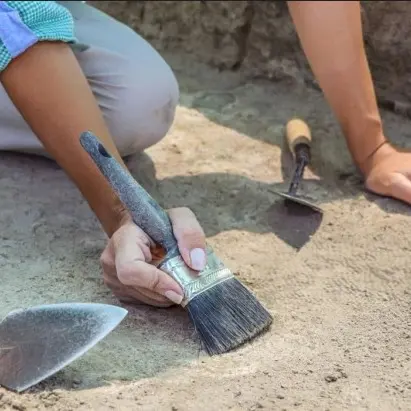
The speaker will present the latest findings from several excavation and survey campaigns he has conducted at the Vaugrenier site.
In protohistoric times, there was a burial mound and a necropolis under slabs, then a Greek sanctuary from Marseille was established on the plain. Under Augustus and his successor Tiberius, a complex of public granaries developed at the intersection of the Via Aurelia, the pond and a beach port. Around 50 AD, the site was flooded, and the settlement moved to the slopes and heights overlooking the valley, to the west of the park. The main activity on the plain became the production of ceramics. Despite its abandonment, port activity remained visible until the 13th century.
Lecture offered by Science pour tous and led by Pascal Arnaud, an antiquity historian, philologist and archaeologist by training. He has long studied the history of southern Gaul in general and its integration into the Roman Empire in particular.
Lecture offered by Science pour tous and led by Pascal Arnaud, an antiquity historian, philologist and archaeologist by training. He has long studied the history of southern Gaul in general and its integration into the Roman Empire in particular.
