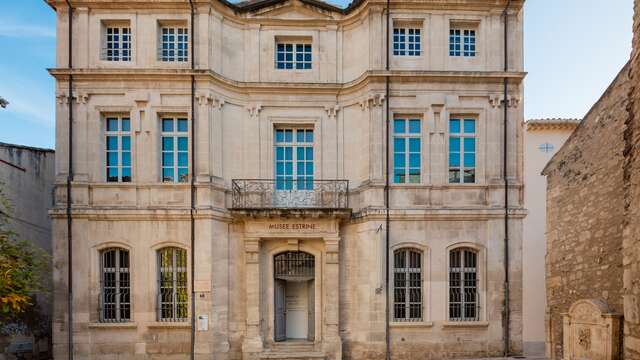



In 2026, the Estrine Museum invites you to discover a new permanent exhibition: Colour, Matter, Texture.
In the history of painting, colour occupies a predominant place. Initially imitative of reality, it later emancipated itself from it, as exemplified by the work of the artist Vincent van Gogh, who paved the way for a new, more subjective and sensitive use of colour.
Within the European avant-garde movements of the twentieth century, colour continued to be the principal focus of artistic experimentation: Albert Gleizes combined it in flat areas with the decomposition of perspective; Robert and Sonia Delaunay, who theorised Orphism, saw in the fragmentation of forms the bursting forth of light and therefore of colour. Piet Mondrian, one of the leading figures of abstract art, developed a new way of composing his works based on straight lines (vertical or horizontal) and primary colours, which were given a determining role in the creation of compositions.
His work would influence many painters such as Geneviève Asse and Geneviève Claisse. A few years later, artists of the École de Paris, including André Marchand and Édouard Pignon, took a different direction, using saturated colour palettes in figurative compositions.
At the turn of the second half of the twentieth century, Léon Zack, like many others, rejected past traditions, and his research led him to seek the hidden truth beyond colour. Mario Prassinos, through drawings, sought in the “non-colours” (white and black) to come closer to the light that emanates from them. Within the Support–Surface movement, Vincent Bioulès turned to abstraction and attempted to restore to colour its independent reality. At the same time, the materiality of colour takes on its full emotional dimension in the work of Giancarlo Bargoni, where the clearly visible brushstroke brings a contrasting chromatic palette to life. Gérard Fromanger, for his part, reinvented colour by revisiting processes such as photography and printing through the isolation of four fundamental colours: blue, red, black and yellow. Finally, in the work of Denis Laget, colour emerges from a thick, muddy material in the full power of its tones.
Through a chronological display, the Musée Estrine invites visitors to discover all the artistic research linked to colour and its materiality.
Within the European avant-garde movements of the twentieth century, colour continued to be the principal focus of artistic experimentation: Albert Gleizes combined it in flat areas with the decomposition of perspective; Robert and Sonia Delaunay, who theorised Orphism, saw in the fragmentation of forms the bursting forth of light and therefore of colour. Piet Mondrian, one of the leading figures of abstract art, developed a new way of composing his works based on straight lines (vertical or horizontal) and primary colours, which were given a determining role in the creation of compositions.
His work would influence many painters such as Geneviève Asse and Geneviève Claisse. A few years later, artists of the École de Paris, including André Marchand and Édouard Pignon, took a different direction, using saturated colour palettes in figurative compositions.
At the turn of the second half of the twentieth century, Léon Zack, like many others, rejected past traditions, and his research led him to seek the hidden truth beyond colour. Mario Prassinos, through drawings, sought in the “non-colours” (white and black) to come closer to the light that emanates from them. Within the Support–Surface movement, Vincent Bioulès turned to abstraction and attempted to restore to colour its independent reality. At the same time, the materiality of colour takes on its full emotional dimension in the work of Giancarlo Bargoni, where the clearly visible brushstroke brings a contrasting chromatic palette to life. Gérard Fromanger, for his part, reinvented colour by revisiting processes such as photography and printing through the isolation of four fundamental colours: blue, red, black and yellow. Finally, in the work of Denis Laget, colour emerges from a thick, muddy material in the full power of its tones.
Through a chronological display, the Musée Estrine invites visitors to discover all the artistic research linked to colour and its materiality.