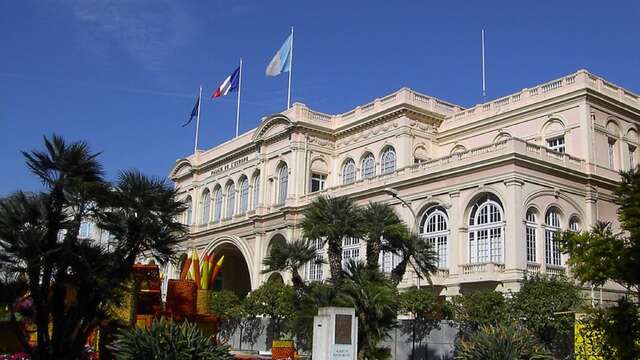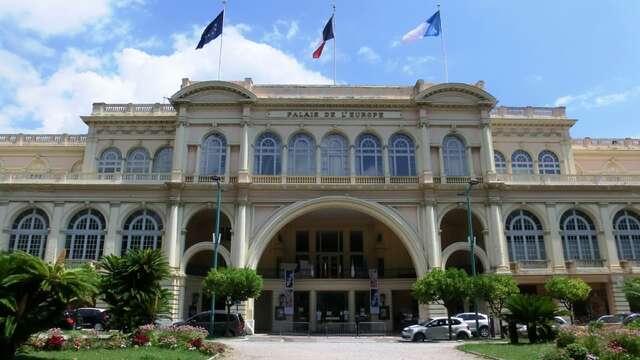



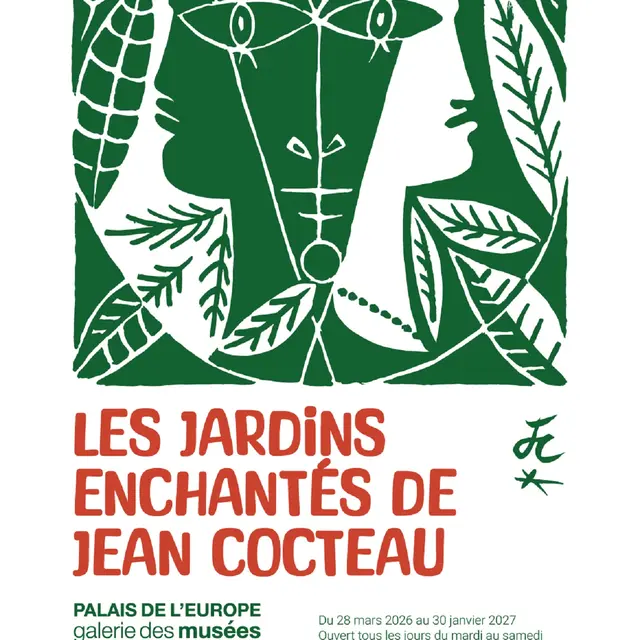
From March 28, the Galerie des Musées will host a new presentation of the Musée Jean Cocteau's Séverin Wunderman collection on the theme of gardens.
In many of the Prince of Poets' visual and film works, vegetation is a source of inspiration. More than a setting, it is strange, translating the mystery of the living and the porosity between man and the world. It breathes, comes alive, and becomes a mirror of the soul. Hence the title of the exhibition: Les jardins enchantés de Jean Cocteau.
- The tour
For this second exhibition at the Galerie des Musées - divided into four sequences - the public will be invited to wander through the imaginary gardens of the protean genius. Loans from the Musée des Beaux-arts de Menton and works by contemporary artists inspired by nature will also be on view.
- First sequence
Lettres fleuries et amicales de Jean Cocteau et ses amis: this sequence will show the importance of epistolary exchanges between Jean Cocteau and his friend Irène Lagut, and between Valentine Hugo and Hubert de Saint-Senoch. Through these examples, visitors will understand the bonds of friendship forged by the poet and his artistic entourage. For Cocteau, letters occupy a central, structuring and integral place in his work, to the point where they can be considered an extension of his creative activity.
- Second sequence
Myths revisited: fauns and nymphs - unicorns: in the work of this protean genius, the common thread is his modern reinterpretation of ancient myths. He adapts them, transposing them into new forms for his own time, through the prism of his personal poetic universe, where symbolism and aesthetics mingle. One of his favorite figures is, of course, Orpheus, his alter ego.
- Third sequence
Onirism and fantastical bestiaries: onirism is present throughout Cocteau's work, as his art is based on what he himself called a logic of the marvelous. He transposes dreams into his drawings by blurring the boundaries between life and death, abolishing linear time, using animated objects and narration. Here, onirism will be shown through particularly poetic works, such as the series of large Beethoven studies and Les Dames du silence.
- Fourth sequence
Jardins du Sud: figure du vivant - Méditerranée: Jean Cocteau spent several periods in the South of France. He left his mark with monumental works from Menton to Fréjus... The artist had a deep bond with the Côte d'Azur, a region he adopted as a creative and inspiring refuge. His favorite place is the city of lemons and its Mediterranean gardens. His Innamorati (Lovers of Menton) series reflects the joie de vivre he felt living on this coast.
Exhibition curator: Sandrine Faraut-Ruelle, head of the Musée Jean Cocteau - Séverin Wunderman collection
Scenography: Ahmad Reshad, artist and scenographer
- The tour
For this second exhibition at the Galerie des Musées - divided into four sequences - the public will be invited to wander through the imaginary gardens of the protean genius. Loans from the Musée des Beaux-arts de Menton and works by contemporary artists inspired by nature will also be on view.
- First sequence
Lettres fleuries et amicales de Jean Cocteau et ses amis: this sequence will show the importance of epistolary exchanges between Jean Cocteau and his friend Irène Lagut, and between Valentine Hugo and Hubert de Saint-Senoch. Through these examples, visitors will understand the bonds of friendship forged by the poet and his artistic entourage. For Cocteau, letters occupy a central, structuring and integral place in his work, to the point where they can be considered an extension of his creative activity.
- Second sequence
Myths revisited: fauns and nymphs - unicorns: in the work of this protean genius, the common thread is his modern reinterpretation of ancient myths. He adapts them, transposing them into new forms for his own time, through the prism of his personal poetic universe, where symbolism and aesthetics mingle. One of his favorite figures is, of course, Orpheus, his alter ego.
- Third sequence
Onirism and fantastical bestiaries: onirism is present throughout Cocteau's work, as his art is based on what he himself called a logic of the marvelous. He transposes dreams into his drawings by blurring the boundaries between life and death, abolishing linear time, using animated objects and narration. Here, onirism will be shown through particularly poetic works, such as the series of large Beethoven studies and Les Dames du silence.
- Fourth sequence
Jardins du Sud: figure du vivant - Méditerranée: Jean Cocteau spent several periods in the South of France. He left his mark with monumental works from Menton to Fréjus... The artist had a deep bond with the Côte d'Azur, a region he adopted as a creative and inspiring refuge. His favorite place is the city of lemons and its Mediterranean gardens. His Innamorati (Lovers of Menton) series reflects the joie de vivre he felt living on this coast.
Exhibition curator: Sandrine Faraut-Ruelle, head of the Musée Jean Cocteau - Séverin Wunderman collection
Scenography: Ahmad Reshad, artist and scenographer