


Caumont-Centre d’Art is dedicating its summer exhibition to Henri de Toulouse-Lautrec (1864–1901), an iconic figure of the Parisian avant-garde at the end of the 19th century. Bringing together nearly a hundred works.
The exhibition explores the artist's exceptional ability to create iconic images and ensure that his models remain firmly embedded in the collective memory.
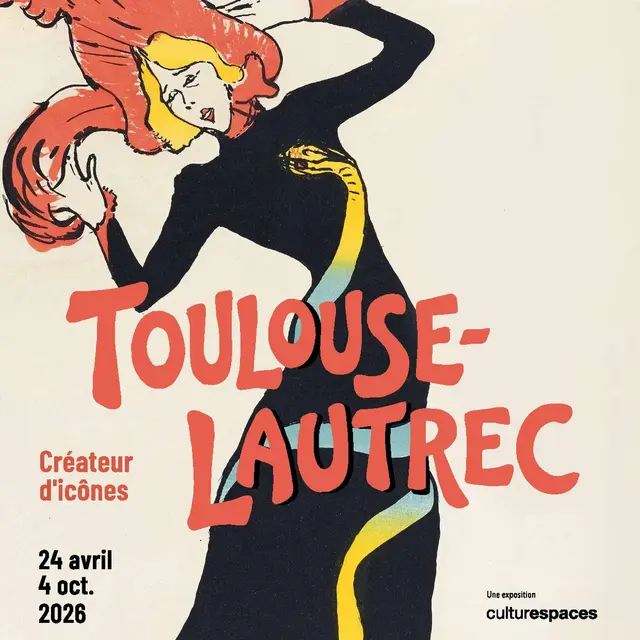
At the end of the 19th century, Paris experienced a golden age of artistic poster art, driven by technical advances, particularly the rise of lithography and color printing processes. Artists such as Toulouse-Lautrec gradually began to explore the field of poster art, turning it into a playground for experimentation and unprecedented stylistic innovation.
A painter of figures with a profoundly human gaze, Toulouse-Lautrec was able to capture the essence of his contemporaries with great freedom. Through nearly a hundred works, the exhibition at the Caumont-Centre d'Art will focus on revealing the means used to explain not only the originality and success of Toulouse-Lautrec's works, but also, and above all, their prodigious longevity. By portraying the celebrities of his time and associating them with immediately recognizable symbols and attributes, Toulouse-Lautrec contributed to their fame and created powerful images that have stood the test of time and elevated them to iconic status. From fleeting celebrities to timeless figures, he created these stars and succeeded in immortalizing contemporary glories by transforming them into symbols of fin-de-siècle Paris.
With its flamboyant scenography, the exhibition invites you to immerse yourself in the atmosphere of Montmartre bohemianism while highlighting the artist's two favorite mediums: lithography and painting. Drawing on a wealth of previously unseen private collections and major museums such as the Toulouse-Lautrec Museum, the Musée d'Orsay, and the Musée Carnavalet, the exhibition explores both intimate and sensitive outdoor paintings and iconic posters dedicated to the great figures of Belle Époque entertainment, such as La Goulue, Aristide Bruant, and Jane Avril, as well as those created for the press, publishing, and advertising. It also addresses the question of theater, particularly through the figure of the voyeuristic spectator, as well as prostitution, which was central to the artist's understanding of the benevolent gaze he cast on his contemporaries. The exhibition will thus offer an opportunity to discover how Toulouse-Lautrec was able, better than anyone else, to capture the essence of Paris during the Belle Époque and the world of entertainment, and will also address his links with his contemporaries such as Pierre Bonnard, with whom he shared a common interest in Japonism.
This exhibition is produced in collaboration with the Toulouse-Lautrec Museum.
Accessible for disabled
At the end of the 19th century, Paris experienced a golden age of artistic poster art, driven by technical advances, particularly the rise of lithography and color printing processes. Artists such as Toulouse-Lautrec gradually began to explore the field of poster art, turning it into a playground for experimentation and unprecedented stylistic innovation.
A painter of figures with a profoundly human gaze, Toulouse-Lautrec was able to capture the essence of his contemporaries with great freedom. Through nearly a hundred works, the exhibition at the Caumont-Centre d'Art will focus on revealing the means used to explain not only the originality and success of Toulouse-Lautrec's works, but also, and above all, their prodigious longevity. By portraying the celebrities of his time and associating them with immediately recognizable symbols and attributes, Toulouse-Lautrec contributed to their fame and created powerful images that have stood the test of time and elevated them to iconic status. From fleeting celebrities to timeless figures, he created these stars and succeeded in immortalizing contemporary glories by transforming them into symbols of fin-de-siècle Paris.
With its flamboyant scenography, the exhibition invites you to immerse yourself in the atmosphere of Montmartre bohemianism while highlighting the artist's two favorite mediums: lithography and painting. Drawing on a wealth of previously unseen private collections and major museums such as the Toulouse-Lautrec Museum, the Musée d'Orsay, and the Musée Carnavalet, the exhibition explores both intimate and sensitive outdoor paintings and iconic posters dedicated to the great figures of Belle Époque entertainment, such as La Goulue, Aristide Bruant, and Jane Avril, as well as those created for the press, publishing, and advertising. It also addresses the question of theater, particularly through the figure of the voyeuristic spectator, as well as prostitution, which was central to the artist's understanding of the benevolent gaze he cast on his contemporaries. The exhibition will thus offer an opportunity to discover how Toulouse-Lautrec was able, better than anyone else, to capture the essence of Paris during the Belle Époque and the world of entertainment, and will also address his links with his contemporaries such as Pierre Bonnard, with whom he shared a common interest in Japonism.
This exhibition is produced in collaboration with the Toulouse-Lautrec Museum.
Accessible for disabled