



Lecture by Luc Thevenon, Historian, Chief Curator of Heritage.
The principal members of the Holy League, founded by Pope Pius V, were Spain and Venice. The Duchy of Savoy provided three ships under the command of Andrea Provana de Leyne. To these navies were added, with the support of Maximilian II, infantry troops supplied by various states of the Holy Roman Empire: Austria, Flanders, and even Poland.
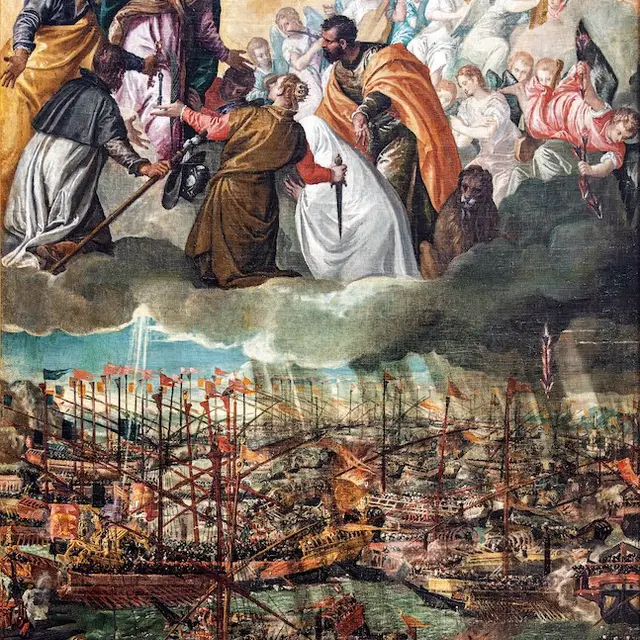
This explains why the Battle of Lepanto was commemorated in works, some of them masterful, as far away as Krakow, Switzerland, and Bavaria. However, many of these works depicting the "Battle of Lepanto" are late. Executed between 1670 and 1720, they correspond precisely to the pontificates of Clement X and Clement XI. During this period, these popes worked to contain the Turkish advance in Europe, then to reduce and repel it, attempting to emulate the unifying role of Pius V. It is in this context that works depicting the famous battle, more than a century later, proliferated in Europe.
And Lepanto continues to inspire artists, including French ones. The immense canvas that Georges Mathieu dedicated to it in 1959 is a testament to this.
This explains why the Battle of Lepanto was commemorated in works, some of them masterful, as far away as Krakow, Switzerland, and Bavaria. However, many of these works depicting the "Battle of Lepanto" are late. Executed between 1670 and 1720, they correspond precisely to the pontificates of Clement X and Clement XI. During this period, these popes worked to contain the Turkish advance in Europe, then to reduce and repel it, attempting to emulate the unifying role of Pius V. It is in this context that works depicting the famous battle, more than a century later, proliferated in Europe.
And Lepanto continues to inspire artists, including French ones. The immense canvas that Georges Mathieu dedicated to it in 1959 is a testament to this.
