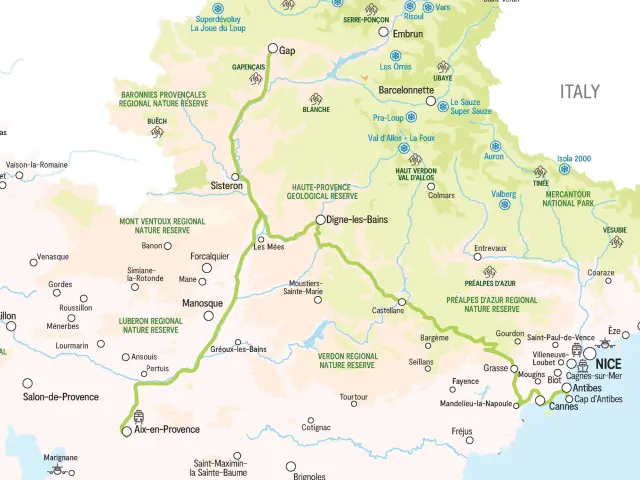
Carte Tour 37
Length: 6 days, 5 nights
Total distance covered: 438 km
Main access points:
- Nice airport
- Nice-Ville train station
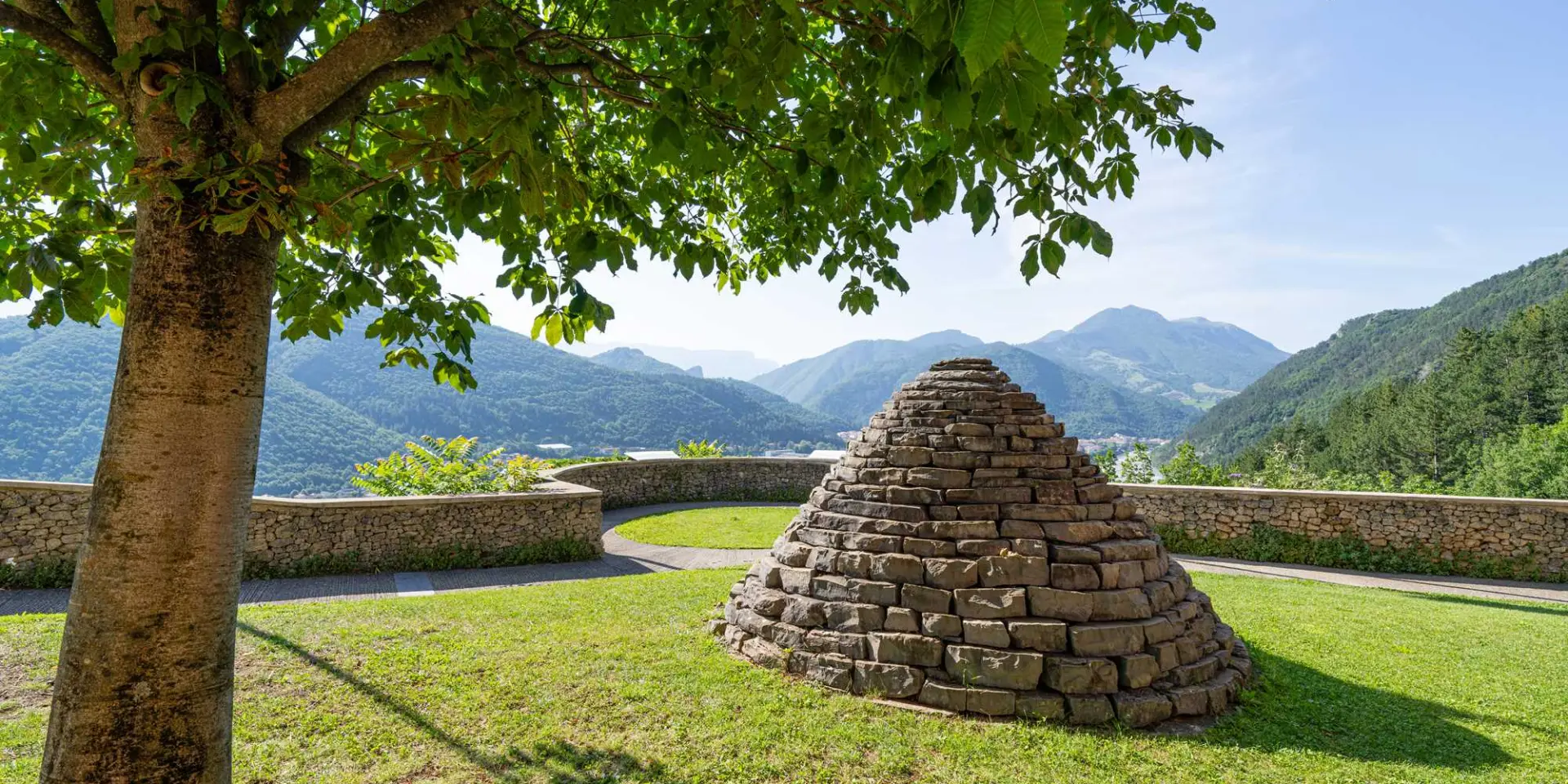
Andy Goldsworthy land art installation in Digne-les-Bains
|
Carte Tour 37
Length: 6 days, 5 nights
Total distance covered: 438 km
Main access points:
You will love
On March 1st, 1815, Napoleon moored on the shores of Golfe-Juan after sailing the sea from the island of Elba. A stele on the port commemorates the event, along with Napoleon’s Column just next door. What was then a modest fishing village has today become a charming seaside resort, perfect for a leisurely stroll. Vallauris boasts a pottery tradition dating back to Gallo-Roman times: visit the town’s pottery studios and explore the Musée Picasso or Musée Magnelli, both showcasing the town’s rich ceramics legacy. A few kilometres away, Villa Thuret in Cap d’Antibes is home to a botanical garden dedicated to acclimatizing exotic plants, where Chilean coconut trees and Afghan palms guarantee a breathtaking change of scenery.
Night in Golfe-Juan
Distance covered on Day 1: 26 km
The Route Napoléon crosses Cannes, famed worldwide for its film festival and stunning Croisette. A stone’s throw from the Festival Palace, a plaque inside Eglise Notre-Dame-de-Bon-Voyage marks the site of the Emperor’s first encampment during his Hundred Days campaign. On the opposite shores of the gulf of La Napoule lies Château de Mandelieu. Originally constructed in the 14th century, the castle was entirely rebuilt in a neo-medieval style by wealthy American couple Henry and Marie Clews in the Twenties. A proud holder of the “Remarkable Garden” distinction, the 10-acre grounds surrounding the site are well worth a visit, alternating formal French and more untamed, English style landscaping, as well as various curiosities including Moorish and Venetian gardens.
Night in Cannes
Distance covered on Day 2: 7 km
Nestled in the inland countryside, between the sea and mountains, Grasse enjoys a gentle microclimate that is particularly conducive to perfume plant growing. During the Renaissance, the tanners who earned the town its renown came up with the idea of perfuming their gloves with local blooms. The idea was so successful that the town – a haven for the Centifolia rose, jasmine and tuberose – was soon baptized the French perfumery capital. The flowers were processed to make essential oils or absolutes and the fragrant raw materials were then blended to create perfumes. The International Perfume Museum relates the town’s history and know-how, listed as UNESCO Intangible Cultural Heritage since 2018. Don’t miss a visit to the greenhouse showcasing perfume plants, where visitors get a chance to breathe in the sweet smells of the perfume ingredients derived from them.
Night in Grasse
Distance covered on Day 3: 20 km
Continuing his journey northwards, Napoleon arrived in Digne-les-Bains. As far back as Antiquity, the town’s thermal springs earned Digne its name and reputation alike, and the waters that flow from them are believed to have soothing and revitalizing properties. Digne also boasts a widespread cultural reach. The Maison Alexandra David-Neel invites visitors to delve into the exciting life and prolific work of the writer and Tibetologist. Art fans can admire the Land Art installations of British artist Andy Goldsworthy, created using natural materials, at the Musée Gassendi and in the neighbouring valleys. Last but not least, Digne also has historic ties with lavender growing. Renowned as the lavender capital, its fields are ablaze with purple in the summer months, while the local distilleries can be visited all year round.
Night in Digne-les-Bains
Distance covered on Day 4: 115 km
Sisteron marked one of the most epic stages of Napoleon’s odyssey. Standing on the former frontier between Provence and the Dauphiné area, the town was a royalist stronghold at the time. When the Emperor learnt that the resistance there had been crushed, he exclaimed, “Soldiers, we are saved, we are in Paris!” A plaque on Rue Saunerie commemorates his lunch that day at the Hôtel du Bras d’Or. Perched on a rocky outcrop overlooking the town, the Citadel really is a sight to behold. Its ramparts boast one of the most breathtaking vistas in Haute-Provence: a 360° panorama with unobstructed views stretching up to 150 kilometres. Down below, the heart of town with its maze of narrow lanes, stone staircases and glimpses of the turquoise waters of the Durance river, is steeped in a picture-postcard atmosphere.
Night in Sisteron
Distance covered on Day 5: 38 km
On March 5th, 1815, Napoleon made his triumphant entry into Gap, where he dined and spent the night at Monsieur Marchand’s inn. A fresco situated on Rue de France commemorates the event. Nestled amid the surrounding peaks, France’s highest prefecture, at an altitude of 735 metres, is undeniably charming. At the crossroads of major trade routes since medieval times, the town’s picturesque cobbled streets, colourful façades and inviting terraces are steeped in a lively atmosphere, with sights including Notre-Dame-et-Saint-Arnoux Cathedral and its impressive bell tower rising to 70 metres. It is built on a site that originally housed a Roman temple dedicated to Apollo, followed by various churches and buildings from 5th century onwards. The current cathedral was built between 1867 and 1905.
Depending on the demands of your custurmers, please contact from the list below the professional best suited to respond.
NA Provence (Groups)
[email protected]
+33 (0)4 42 264 034
www.naprovence.com