

Description
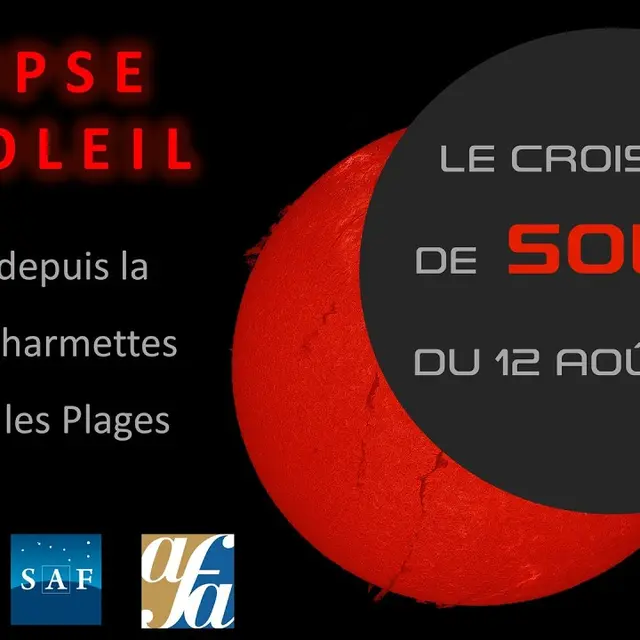
The solar eclipse will be total from certain regions of Spain and will be partial (96.5% solar occultation) for us.
To mark the occasion, the VEGA Club in Ollioules is organizing various activities and observation sessions related to this event.
On the program:
From 4:30 p.m. to 7:00 p.m.:
- Understanding the phenomenon of eclipses using models
- Observing a solar eclipse without eclipse glasses
- Observing the Sun through a telescope
- Mini exhibition on eclipses
Starting at 7:30 p.m.:
- Individual observation of the eclipse using eclipse glasses
- Live YouTube broadcast featuring:
- Tracking the eclipse observed in H-Alpha
- Characteristics of the August 12, 2026, eclipse
- The Sun and the Moon: Key Players in the Eclipse
- Why and How Solar Eclipses Occur
- A Few Historic Eclipses
- Live broadcast of the totality as observed from Spain
Free distribution of “special eclipse” glasses, provided by the city of Six Fours les Plages, before the eclipse begins.
When the Moon passes between the Earth and the Sun, the Sun’s light is blocked.
Total solar eclipses are visible only along a narrow band of the Earth’s surface each time. However, on either side of this band, over several thousand kilometers, observers will be able to enjoy a partial eclipse.
Start of the eclipse: 7:32 p.m. (elevation 11.8° – azimuth 279.3°)
Maximum eclipse (96.5%) 8:25 p.m. (elevation 2.3° - azimuth 288.2°)
Sunset 8:42 p.m.
End of the eclipse: 9:16 p.m. (Sunset!)
Important note:
Event canceled in case of bad weather—please check the page linked below if in doubt:
https://www.oagc.fr/eclipse-soleil-2026
- Wearing “special eclipse” glasses is essential.
- Even with proper equipment, do not look at the Sun for more than 3 consecutive minutes.
- Pay special attention to children, who are often less aware of the danger.
- Eclipse glasses are not suitable for children under 3 years of age; therefore, it is recommended that they not observe the phenomenon.
- Cameras, binoculars, and telescopes concentrate light and require specific solar filters placed in front of the lens.
WARNING: The Gros Cerveau Observatory in Ollioules will be closed—the eclipse cannot be observed at this location